Exploring Foundational Nutrition
An independent educational resource dedicated to understanding the principles of balanced dietary practices, macronutrients, micronutrients, and the broader context of holistic well-being.
Explore Nutritional GuidelinesThe Pillars of Balanced Eating
An overview of the core components that constitute a balanced diet, presented as foundational elements of nutritional understanding.
Macronutrient Balance
Carbohydrates, proteins, and fats each serve distinct physiological functions. Understanding their proportional roles in energy metabolism forms the basis of nutritional literacy.
Micronutrient Sufficiency
Vitamins and minerals act as essential regulators of metabolic processes. Dietary diversity is widely recognised as a key factor in achieving adequate micronutrient intake.
Food Category Awareness
Classifying foods into broad groups — vegetables, fruits, grains, legumes, proteins — provides a structural framework for understanding dietary composition and variety.
Hydration Principles
Water is a fundamental constituent of the human body. Its role in thermoregulation, nutrient transport, and cellular function is explored across established nutritional literature.
Preparation & Processing
How food is prepared affects its nutritional characteristics. Techniques such as steaming, fermentation, and minimal processing are documented across culinary and nutritional research.
Lifestyle Integration
Dietary patterns do not exist in isolation. Their relationship with physical activity, sleep quality, and environmental factors forms an important dimension of holistic well-being research.
Macronutrients Explained
Macronutrients represent the three primary categories of nutrients that provide the body with energy. Each plays a distinct biochemical role and is found across a wide range of whole foods.
- Carbohydrates — The primary energy substrate for cellular function, found in whole grains, legumes, fruits, and vegetables. Complex carbohydrates are distinguished from simple sugars by their molecular structure and digestive rate.
- Proteins — Composed of amino acid chains, proteins are integral to structural integrity, enzymatic activity, and immune function. Sources include legumes, fish, eggs, dairy, and plant-based alternatives.
- Fats — Lipids serve as energy reserves, facilitate fat-soluble vitamin absorption, and contribute to hormonal regulation. Unsaturated fats from nuts, seeds, and oily fish are distinguished from saturated variants in nutritional literature.

Micronutrients: The Essential Regulators
Vitamins and minerals, though required in smaller quantities than macronutrients, perform indispensable regulatory roles in virtually every physiological system. Their sources are found across the spectrum of whole foods.
Key Vitamins and Their Food Sources
- Vitamin A — leafy greens, orange vegetables, eggs
- Vitamin C — citrus fruits, bell peppers, kiwi, broccoli
- Vitamin D — oily fish, fortified dairy, sunlight exposure
- Vitamin E — nuts, seeds, sunflower oil, spinach
- Vitamin K — dark leafy greens, fermented foods
- B-complex vitamins — whole grains, legumes, eggs, meat
- Folate — lentils, asparagus, leafy greens, citrus
Essential Minerals and Their Food Sources
- Calcium — dairy products, fortified plant milks, leafy greens
- Iron — legumes, dark leafy greens, red meat, tofu
- Magnesium — nuts, seeds, whole grains, dark chocolate
- Potassium — bananas, potatoes, beans, tomatoes
- Zinc — shellfish, legumes, seeds, whole grains
- Selenium — Brazil nuts, fish, sunflower seeds
- Iodine — seaweed, dairy, iodised salt, seafood
The Spectrum of Food Categories
Classifying foods into broad groups provides a structural framework for discussing dietary composition, variety, and the general characteristics of different food types.

Fruits
Rich in natural sugars, dietary fibre, and a broad spectrum of vitamins and antioxidants. Fruits represent one of the most diverse food groups across climatic regions.

Vegetables
A foundational food group characterised by low energy density and high micronutrient concentration. Non-starchy vegetables are prominent in most traditional dietary patterns globally.
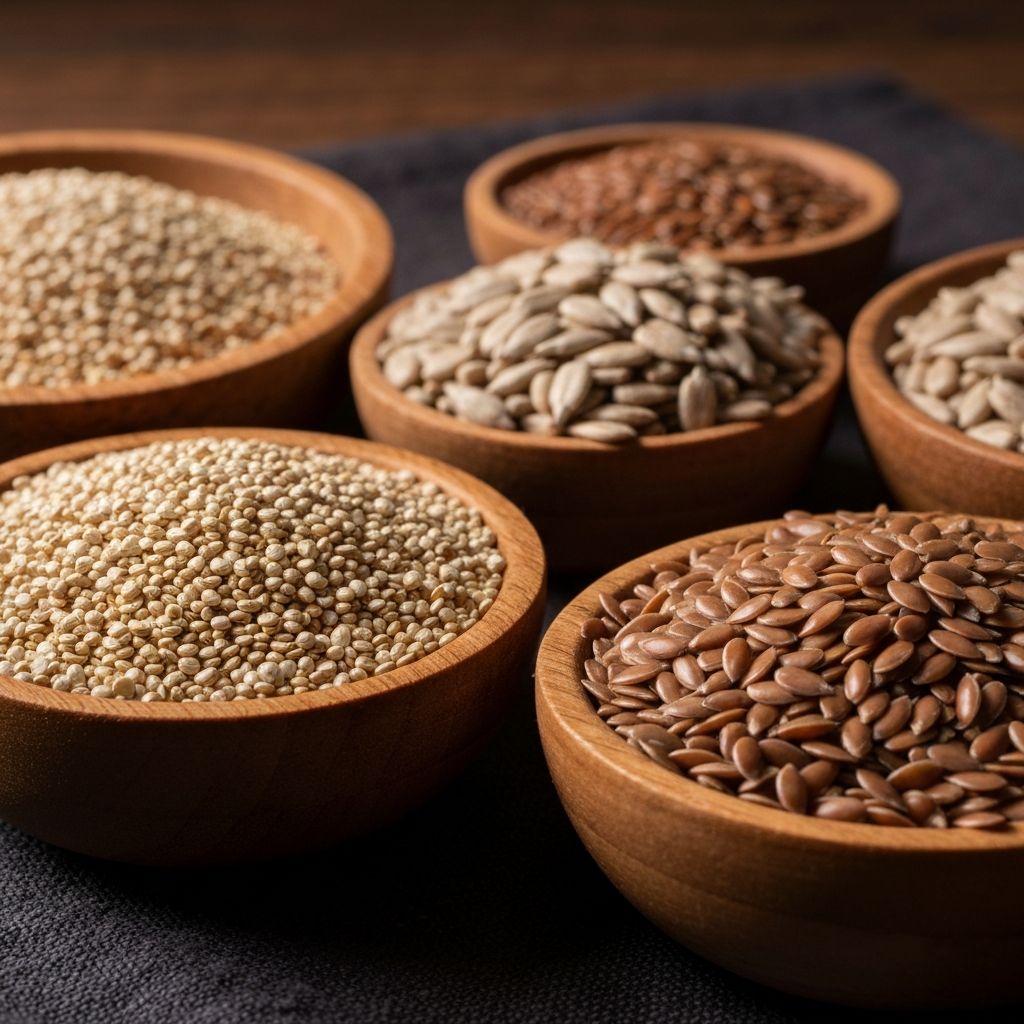
Whole Grains
Cereal grains in their whole form retain the bran, germ, and endosperm, preserving their fibre content and micronutrient profile compared to refined counterparts.
Proteins
Legumes & Protein Sources
Lentils, beans, chickpeas, and various animal-derived proteins form a broad category providing amino acids and minerals essential to numerous physiological functions.
Hydration: A Fundamental Component of Health
Water is not merely a beverage — it is a primary constituent of every living cell, a medium for biochemical reactions, and a critical factor in thermoregulation. Nutritional literature consistently identifies adequate fluid intake as a cornerstone of physiological function.
Beyond plain water, fluid intake encompasses contributions from whole fruits, vegetables, herbal infusions, and broths. Understanding the sources and daily patterns of fluid consumption provides a useful lens for examining broader dietary habits across different populations and climatic contexts.
Research into hydration patterns also intersects with discussions of electrolyte balance — the interplay between sodium, potassium, magnesium, and fluid intake — which forms a distinct and well-documented area of nutritional science.
The Historical Evolution of Dietary Patterns
Human dietary practices have undergone profound transformations across centuries, shaped by geography, agriculture, culture, and economic development. A chronological perspective reveals the diversity and adaptability of human nutritional behaviour.
Hunter-Gatherer Dietary Patterns
Pre-agricultural populations relied on diverse local ecosystems, consuming seasonal plants, tubers, seeds, and hunted or fished animal proteins. Dietary composition varied significantly by region and season.
The Agricultural Revolution
The domestication of cereals, legumes, and livestock fundamentally altered human dietary patterns. Grain-based staples such as wheat, barley, rice, and maize became central to emerging civilisations across Asia, the Middle East, and the Americas.
The Columbian Exchange
The exchange of crops between the Americas, Europe, Africa, and Asia introduced foods such as tomatoes, potatoes, maize, cacao, and chillies to populations that had no prior knowledge of them, permanently reshaping global culinary traditions.
Industrialisation and Food Processing
Industrial development introduced large-scale food production, preservation technologies, and the widespread availability of refined foods. This era marked the beginning of documented nutritional deficiency research.
Nutritional Science and Dietary Guidelines
The formalisation of nutritional science as an academic discipline produced systematic research into macronutrients, micronutrients, and dietary patterns. Public health organisations began developing evidence-based dietary frameworks for population guidance.
Understanding Food Preparation Techniques
The method by which food is prepared influences its physical structure, flavour profile, and nutritional characteristics. Research documents a range of preparation approaches across culinary traditions worldwide.

Steaming
Steaming uses moist heat without submerging food in water, a method documented in both Asian and European culinary traditions. Nutritional literature notes that water-soluble vitamins are generally better retained in steamed preparations compared to boiling, as nutrients are not leached into cooking water.
The technique is applicable to a wide range of vegetables, fish, and grain-based preparations, and is recognised in public health literature for its structural preservation of food texture.

Baking and Dry Heat
Dry heat preparation methods such as baking and roasting apply elevated temperatures in an oven environment. The Maillard reaction — a chemical process occurring between amino acids and reducing sugars — produces characteristic flavours and aromatic compounds during baking.
Whole grain baking in particular preserves the fibre and mineral content of cereals, with documented differences in glycaemic characteristics compared to refined grain products.

Fermentation
Fermentation is one of the oldest known food preservation techniques, utilising microbial activity to transform the chemical composition of raw ingredients. Foods such as yoghurt, kefir, kimchi, miso, and sourdough bread are produced through controlled fermentation processes.
Research into fermented foods examines their contribution to microbial diversity in the gut microbiome — an emerging and extensively studied area within nutritional science and food research.
The Interplay of Nutrition and Lifestyle
Dietary practices are understood within a broader framework of lifestyle factors. Research consistently examines the relationships between nutrition, physical activity, and sleep as interconnected components of overall well-being.
Physical Activity
Nutritional science intersects with exercise physiology in examining how dietary composition supports or is influenced by levels of physical activity. Research explores energy expenditure, macronutrient utilisation during movement, and the role of dietary timing relative to activity patterns.
Public health frameworks typically present physical activity and dietary habits as complementary dimensions of lifestyle, neither functioning optimally in the absence of the other.
Sleep and Rest
The relationship between dietary patterns and sleep quality is an area of growing interest in nutritional research. Studies examine how the timing of food intake, composition of evening meals, and specific nutrients may relate to sleep architecture and circadian rhythm regulation.
Conversely, research also investigates how sleep duration and quality may influence appetite-regulating hormones, food preference patterns, and overall dietary behaviour.
Dietary Myths and Misconceptions
Nutritional science is frequently misrepresented in popular discourse. The following is an informational review of common misunderstandings, presented alongside established factual context.
Carbohydrates as a broad food category are often characterised as detrimental, particularly in popular diet culture contexts.
Factual ContextCarbohydrates are the primary energy source for brain and muscle function. Nutritional research consistently distinguishes between whole, fibre-rich carbohydrate sources (vegetables, legumes, whole grains) and refined, low-fibre alternatives, noting that their physiological effects differ substantially. Public health dietary frameworks in most countries include carbohydrates as a significant component of recommended dietary patterns.
Dietary fat is uniformly associated with negative health outcomes in certain popular narratives.
Factual ContextFats are an essential macronutrient, required for the absorption of fat-soluble vitamins (A, D, E, K), hormonal production, and cellular membrane integrity. Nutritional research distinguishes between different types of fatty acids — monounsaturated, polyunsaturated, saturated, and trans fats — noting that their structural and metabolic properties differ considerably. Sources such as avocado, nuts, seeds, and oily fish are prominently featured in most evidence-based dietary frameworks.
The timing of food consumption in the evening is often cited as an independent determinant of body weight changes.
Factual ContextNutritional research examining chrono-nutrition — the study of meal timing and its metabolic implications — presents a more nuanced picture. While circadian biology does influence metabolic processes, research generally indicates that total energy and nutrient intake over time, rather than the specific hour of consumption, is the more substantial variable. Studies on late-evening eating patterns continue to explore potential associations with sleep quality and appetite regulation.
Organic certification is frequently assumed to correlate with a substantially higher nutrient density in food products.
Factual ContextSystematic reviews of comparative nutritional studies on organic and conventionally grown produce generally report modest or statistically insignificant differences in macronutrient and micronutrient content. Research in this area continues, with some studies noting differences in specific polyphenol compounds. The organic label primarily relates to production methods and pesticide use, rather than being a formal nutritional quality designation.
Short-term restrictive eating programmes are widely marketed under the premise of "detoxifying" the body through specific food combinations or elimination protocols.
Factual ContextThe term "detox" as applied to dietary practices is not a recognised concept in nutritional biochemistry. The liver, kidneys, and lymphatic system continuously perform metabolic processing and filtration functions. Nutritional literature examining short-term elimination diets focuses primarily on their effects on subjective well-being and dietary behaviour patterns, rather than confirming any specific toxin removal mechanism attributable to dietary intervention.
Glossary of Nutritional Terms
A compiled reference of key terms used throughout this site, providing concise, neutral definitions drawn from established nutritional science literature.